
How to Compare Landscape Design Quotes (2026 Guide)
How to Compare Landscape Design Quotes: What Actually Matters
You've gotten two or three landscape design quotes. One's half the price of the other. One includes a full plan; the other is a page of plant names and a rough sketch. Which one do you trust?
This guide breaks down exactly what to look for when comparing landscape design quotes — and why the lowball option almost always costs more in the long run.
What Landscape Design Quotes Should Include
Legitimate landscape design quotes aren't only a price. They need to be a document that tells you what you're getting.
Here's the baseline:
A Written Scope of Work
Site assessment details (soil, drainage, sun exposure, existing vegetation)
Specific deliverables (plan drawings, plant schedule, irrigation layout, hardscape specs)
Phasing and timeline
What's explicitly not included (construction, maintenance, etc.)
A Plant Schedule With Rationale
Not just "oak, maple, juniper." A proper plan explains why each plant is specified for its location — soil tolerance, mature size relative to hardscape, water needs, seasonal interest. If you can't tell why a plant is where it is, you're getting a shopping list, not a design.
Irrigation and Drainage Considerations
Any quote that doesn't address water — how it moves across your property, where it collects, how the irrigation system is zoned — is incomplete. This is where the cheap quotes fail most visibly, because it's the part that's invisible until something's already dying.
Maintenance Realism
A good plan accounts for what the landscape will need after installation. If the quote includes a maintenance recommendation or a care schedule, that's a sign the designer is thinking about year three, not just install day.
Having said that, most quotes assume maintenance is non-negotiable. Many low-ball quotes are built to require maintenance, because the estimator's core business is maintenance; they're often not trained in design.
The Red Flags in Cheap Landscape Design Quotes
Here's the uncomfortable truth: the lowest quote is usually the most expensive option over time.
Here's why:
"Mow-Blow-Go" Quotes
These are quotes for installation, not design. The scope is: dig holes, set plants, leave. There's no site analysis, no design rationale, no long-term thinking. The plants go in the ground and that's the last you hear from the designer.
What happens next: Plants die because they're in the wrong soil, the wrong sun, or the wrong spot relative to irrigation. You're back to the nursery in 18 months replacing what didn't take — at retail price, with no plan guiding the replacement.
Boilerplate Plans
Some designers use a template and swap plant names based on budget. The layout is more or less the same for every property; only the species change. You can often spot this because the plan looks like it could be dropped onto a completely different lot with no changes.
What happens next: The design doesn't solve your site's actual problems — the drainage issue in the back corner, the shade from the neighbor's tree, the slope that washes soil off the patio. You pay for a design and get a catalog page.
No Irrigation or Drainage Consideration
If the quote doesn't mention how water will be managed, it's not a landscape design — it's a plant installation. The designer didn't assess your site's hydrology, which means they didn't actually design for your property.
What happens next: Water pooling in low spots, plants drowning in summer irrigation, dry spots that scorch in July. You end up paying a separate contractor to fix drainage problems the design should have prevented.
The Long-Term Cost of a Lowball Quote
Here's the math that homeowners usually don't run until it's too late:
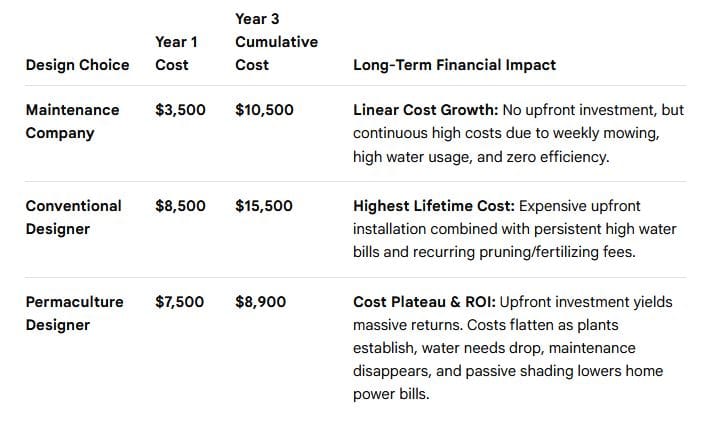
Not All Landscape Quotes Are Created Equal
The lowball quote saves you money on day one. It costs you more by year three.
The plants that die, the water that's going to the wrong place, the maintenance that's higher because the design doesn't account for your site — it all adds up.
A properly designed landscape actually reduces your ongoing costs:
Right plants in right places = fewer replacements, less water
Proper drainage design = no surprise erosion or water damage
Integrated irrigation zoning = lower water bills
Hardscape and plant selection for your climate = less seasonal maintenance
And there's the property value factor: a well-designed, healthy landscape increases property value measurably. A landscape that's half-dead by year two doesn't.
A low-cost quote may provide little more than a quick sketch, verbal description, template-based plant list, or attractive rendering—without the site analysis needed to account for soil, sun, drainage, water, ecology, and buildability.
More comprehensive planning combines precise CAD documentation with landscape architecture and permaculture expertise, coordinating hardscape, grading, planting, water systems, phasing, and long-term property performance in one cohesive plan.
The right comparison is not simply the fee; it is what the quote includes, how thoroughly it responds to your property, and how much uncertainty and cost it can prevent later.
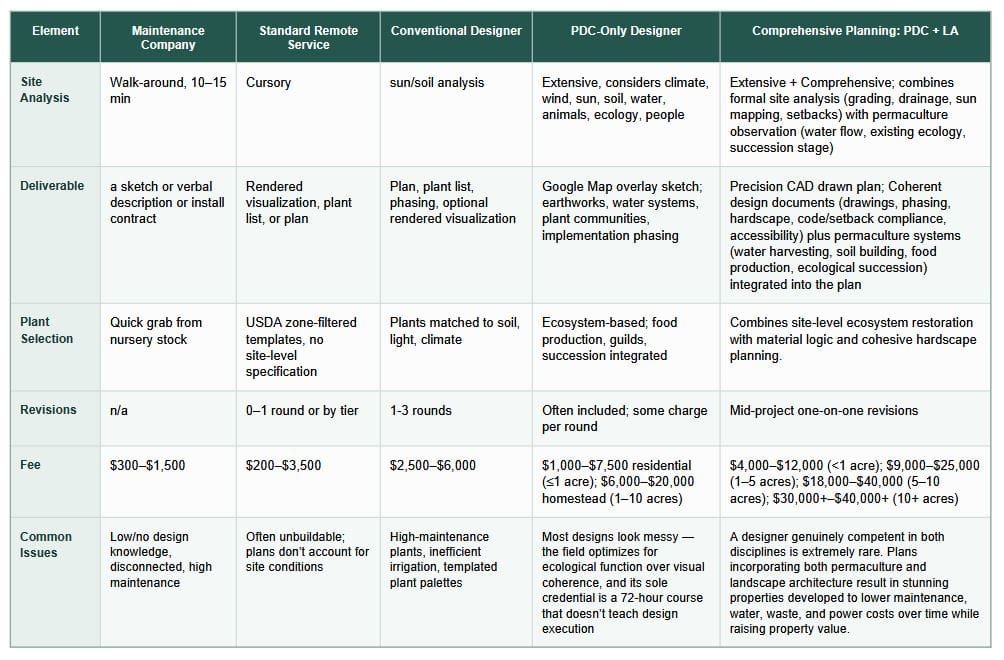
How to Evaluate Whether a Quote Is a Real Design
Run any quote you receive through this checklist:
[ ] Does it reference a site visit or assessment (is it buildable)?
[ ] Does it include a plan drawing (not just a plant list)?
[ ] Is there a rationale for plant placement (sun, soil, mature size)?
[ ] Does it address irrigation and drainage?
[ ] Is there a maintenance or care recommendation?
[ ] Is the scope of work specific, or is it vague ("landscape installation")?
[ ] Does the timeline account for seasonal planting windows?
[ ] Are materials and plant sizes specified (not just species)?
If a quote checks fewer than five of those boxes, it's probably an installation estimate, not a design.
What To Do With Your Quotes
Once you've evaluated what you've received, the next step is getting a quote that actually answers your property's specific needs.
Get a comprehensive landscape design quote →
My quotes include a full site assessment, a written design plan with plant rationale, irrigation and drainage considerations, and a maintenance outlook — so you're comparing apples to apples, not a design to a plant list.
Frequently Asked Questions (FAQ)
How do I know if a landscape quote is fair?
Compare it against two other quotes for the same scope. If the middle of three is within ~15% of what you'd expect for your area and project size, you're in the fair zone. But scope matters more than price — a quote that's 40% lower is often scoping less work, not doing the same work cheaper.
Why are quotes so different from each other?
Because they're usually not quoting the same thing. One may include a site assessment, drainage analysis, and irrigation planning; another may be a plant list and a rough sketch. Before comparing prices, line up the deliverables. A $1,500 plan that says "shrubs" and a $5,000 plan that specifies varieties, sizes, quantities, and water strategy are not the same product.
What should landscape design quotes include?
At minimum: a written scope of work that includes site analysis, a plan drawing (not just a plant list), plant specifications, irrigation and drainage considerations, a timeline, and a clear statement of what's not included. If a quote is just a price and vague description or idea, it's likely an installation estimate, not a design.
How many quotes should I get?
Two to three is the sweet spot. Three lets you spot an outlier. But send every designer the same brief and budget, or the quotes won't be comparable. More than three usually wastes your time and theirs.
Are the cheapest landscape design quotes the best value?
Almost never. The lowest quote is usually scoping the least work — no site analysis, no design rationale, no long-term planning. The disconnected hardscape and plants go in the ground and that's the end of the relationship. Over three to five years, the replacements, water waste, and maintenance that a proper design would have prevented typically cost more than the difference between the quotes.
Do I need a design before getting installation quotes?
Yes. A plant list with sizes and quantities is not a design — it's a shopping list. What you need is a plan that accounts for your site's specific conditions (soil, drainage, sun, slope) and explains why each plant is placed where it is. Without that, every installer is guessing at scope, and their quotes won't be comparable.

HEY, I’M JADENE…
How do you handle a mole invasion of your front yard? What can you grow in Southern California? In North Carolina? In Texas?
I write about these topics and more, from plants, pollinating insects and birds, beneficial wildlife, soil, water, food, neighbors, and how to make money from your property.
In this blog I hope to provide you with valuable free articles to help you solve the problems in your landscape and take advantage of the opportunities it presents.
To see posts about topics that interest you, send me a request.


JOIN MY MAILING LIST
© 2004-2025 Jadene Mayla, All Rights Reserved.