
AI Landscaping Design: Why an Image Does Not Replace a Landscape Plan
A Beautiful AI Image Is Not the Same As a Landscape Plan
A homeowner recently showed one of the landscape installation contractors I work with an AI-generated image for their property. The image depicted terraced planting beds, a curved stone path, a small seating area, and lush planting. It made the project look straightforward.
At the actual site, the contractor had already found a different reality though: a yard that sloped toward the house, heavy clay soil, water collecting after major rains, mature tree roots along one edge, and limited access for bringing in materials. The proposed terraces would require grading and drainage work. The path crossed persistently wet ground. Several plants shown in the image were not suited to the property’s conditions.
His training in construction management didn't include knowledge of all the considerations that go into landscape design, so his attempts to visually convey what he wanted to build for this homeowner just kept confusing them. The couldn't understand his concept. That's what drove them to use AI to generate a conceptual image.
The problem was not that the image lacked visual appeal. The problem was that it created confidence without supplying the information required to make sound decisions.
Ultimately, the contractor reached out to me to provide a professional plan that both clarified the vision to the client (and contractor) and considered all factors before jumping to any one conclusion about what best met the needs of the clients - and their property.
If you are considering AI landscaping design, remember that a generated image cannot evaluate the drainage, slope, soil, access, trees, utilities, or day-to-day use of your yard. It can make a landscape solution look complete before the actual design questions have even been asked.
Online Landscape Design: The Complete Guide — Explore my comprehensive guide to online landscape design for the full overview, key concepts, and related resources.
An Image Seems Certain
AI-generated landscape images are persuasive because they present a finished result. The plants are full. The paths are clean. The retaining walls are stable. Every feature appears to fit together.
But this visual certainty is not site knowledge.
Finished Appearance Is Not Feasibility
An image generator does not visit the property. It does not observe where runoff moves during a storm, identify compacted soil, measure available space, locate utility lines, assess tree-root zones, or evaluate the access needed to install materials.
It also can't know whether a homeowner wants to manage an intensive garden, needs a safe route through the yard, or has a budget that requires a project to be phased.
AI Can Answer Without Understanding
AI can generate an attractive answer without understanding the question.
A striking photo of a finished feature — a wall, a path, a patio — can sell a vision that the site itself may not support. Maintenance outfits or even install contractors often use quick sketches or AI imagery for exactly that purpose - because they often work to entice homeowners with something that looks good to the untrained eye.
That visual confidence is what makes a generated image potentially misleading and not a viable substitute for proper landscape planning.
The Property Decides
Landscape design begins with the conditions of the land, not with a finished-looking picture.
Before specific elements such as a patio, path, planting bed, retaining wall, garden beds, or lawn conversion is proposed, a professional site-based design process should consider what the property can support.
Conditions Need To Shape The Plan
A real landscape plan needs to account for:
How water moves, collects, infiltrates, erodes soil, or affects structures
Slopes, grade changes, and the feasibility of terracing or retaining
Soil texture, compaction, drainage, and preparation requirements
Sun, shade, reflected heat, wind, and seasonal exposure
Mature trees, root zones, existing vegetation, and habitat
Structures, utilities, property constraints, and installation access
How residents actually use the property for arrival, gathering, gardening, pets, play, storage, and maintenance
Budget, construction priorities, sequencing, and realistic long-term care
These factors determine what will work. They also determine what may look good initially but fail later, create more work, or require expensive correction down the line.
The Contractor's Reality Check
In the real-world example I talked about earlier, the installation contractor had trouble getting his concept across. The homeowner turned to an AI image to show what they wanted instead.
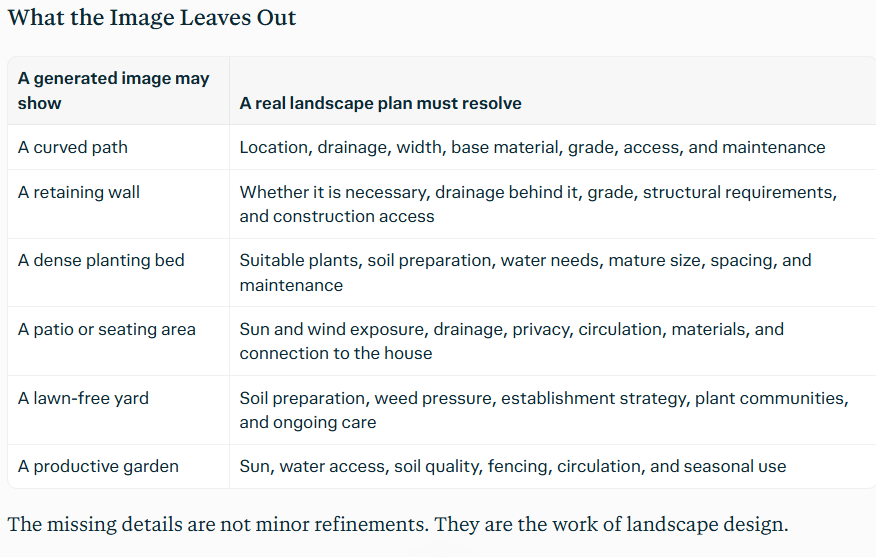
The homeowner's interest in a more natural feel, a place to sit outside, and an easier way through the yard was valid. But the pictured solution was not ready to build. The path location needed to change because of wet ground. The terraced appearance involved grading and drainage considerations that the image concealed. The planting approach needed to respond to the site's actual soil, moisture, and light rather than the generic plants the tool supplied. And the rest of the yard - not shown in the photo - needed to be planned.
False Confidence Can Get Expensive
The risk of AI-generated landscape imagery is not merely that the final result may look different. It is that the image can encourage homeowners to make decisions before understanding the site.
A path installed in the wrong place can stay wet or wash out. A wall treated as a decorative feature can introduce drainage and structural problems. Plants selected for the image rather than the property can struggle or die. A patio can worsen runoff, interfere with roots, or occupy the least comfortable part of the yard.
These issues become more consequential when a project involves:
Drainage problems, erosion, or runoff near a structure
Slopes, terraces, retaining walls, or substantial grade changes
Mature trees and sensitive root zones
Large lawn conversions or new planting areas
Native plants, habitat goals, or ecological restoration
Edible gardens, orchards, or food-producing landscapes
Privacy planting, pathways, patios, or other outdoor living features
A project that must be installed in phases
A professional design process reduces uncertainty before materials are ordered and construction decisions are made.
Site Based Design Is The Answer
Eco-Logic provides professional, site-based landscape design for real properties.
That means beginning with the land itself: its users, constraints, and opportunities. It means clarifying what homeowners want the landscape to do—not only how they want it to look. It means developing a coordinated direction that can guide decisions about planting, circulation, usable outdoor space, ecological function, maintenance, and implementation.
The result is not a visual presented as a solution. It is a carefully considered plan built around the conditions that will determine whether the landscape succeeds.
Ready For A Landscape That Works In Real Life?
A generated, quickly sketched, or beautifully rendered image may be visually persuasive. Your property is still the authority. Your property—not a generated image—must guide the decision. Quick sketches, polished renderings, and AI-generated concepts may help sell a project, but a professional landscape plan is what solves the property’s real issues and creates useful outdoor space.
If you need a landscape that works beyond the screen—one that accounts for water movement and drainage, slope and soil, sun and shade, existing trees and vegetation, utilities and access, the way people use the property, construction priorities, and long-term care—Eco-Logic provides the professional, site-responsive design process AI cannot replace.
Ready to explore what your property can actually support? Schedule a FREE Strategy Session to discuss your goals, site conditions, and the next practical step for your landscape.

HEY, I’M JADENE…
How do you handle a mole invasion of your front yard? What can you grow in Southern California? In North Carolina? In Texas?
I write about these topics and more, from plants, pollinating insects and birds, beneficial wildlife, soil, water, food, neighbors, and how to make money from your property.
In this blog I hope to provide you with valuable free articles to help you solve the problems in your landscape and take advantage of the opportunities it presents.
To see posts about topics that interest you, send me a request.


JOIN MY MAILING LIST
© 2004-2025 Jadene Mayla, All Rights Reserved.